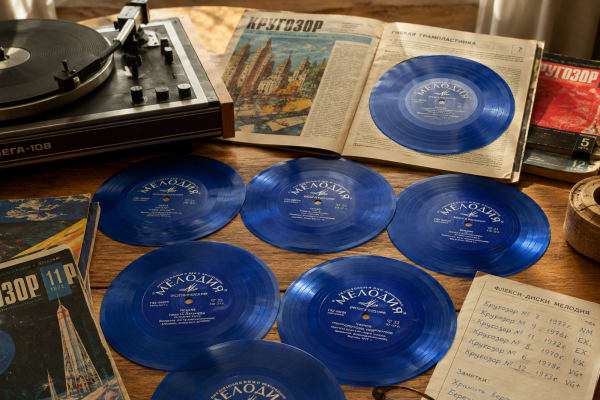
Picture yourself picking up a magazine from a newsstand, flipping through its colorful pages, and finding that several of those pages are actually records. Not illustrations of records. Not advertisements for records. Real, playable discs, pressed directly into the pages, waiting to spin on a turntable.
That was Krugozor...
A Magazine Born in the Khrushchev Thaw
Krugozor launched in 1964, during a period when Soviet cultural life was loosening, cautiously, around the edges. The Khrushchev Thaw had cracked open a window toward the wider world, and there was real appetite among Soviet citizens for culture that felt modern and alive. The magazine's title translates roughly as "horizon" or "outlook," which tells you something about the ambitions baked into the project from the start. Published by Melodiya in partnership with Soviet print institutions, it was positioned as a popular science and culture magazine — not a music publication per se, but something far more ambitious.
The target audience was broad. Krugozor wasn't aimed at music specialists or academics. It was designed for the curious general reader: factory workers, students, engineers, teachers, the kind of people who might not have access to record shops in their region but who wanted to engage with culture, ideas, and sound. At its peak, the magazine had a print run reaching hundreds of thousands of copies per issue. In a country with eleven time zones and chronic shortfalls in consumer goods, this kind of reach was genuinely remarkable.
What Exactly Is a Flexi Disc?
A flexi disc — known in Russian as sonofon or, more colloquially, gibkaya plastinka — is a thin, flexible sheet of plastic with a groove cut into its surface, just like a conventional record. It plays on a standard turntable, costs a fraction of what pressed vinyl costs to manufacture, and can be folded, mailed, or bound into a magazine without any special packaging. Nowhere did the format find such a vast, sustained, and culturally serious application as in the Soviet Union — and Krugozor was the reason why. For a full account of the format's history, how it works, and how it was used across the Eastern Bloc, be sure to read our article on flexi discs.
The Technology That Made Mass Culture Possible
Soviet flexi discs were typically cut at 33⅓ RPM and ran for a few minutes per side, roughly equivalent to a single song or a short spoken-word piece. The sound quality was noticeably inferior to standard vinyl — thin, sometimes prone to surface noise, easily warped by heat or improper storage. Anyone who has tried to play an old Krugozor disc on a modern turntable knows the experience: a slightly ghostly, compressed sound, like music heard through a wall. But for Soviet households in the 1960s and 1970s, many of whom had limited access to commercial records, that sound was extraordinary. It was something. It was music arriving in the mail.
Each issue of Krugozor typically contained between four and six flexi discs, bound into the magazine's pages. The discs were printed on one side with the audio groove and on the reverse with color artwork, photographs, or design elements that matched the magazine's visual layout. This meant the discs themselves functioned as part of the magazine's graphic design — you could read the magazine and then peel out a disc and play it. It was an elegant solution to a logistical challenge, and it gave the publication a physicality that no purely text-based magazine could match.
Far More Than a Music Magazine
Here is where Krugozor becomes genuinely fascinating, even beyond the novelty of the format. The publication was never simply about pop songs. Its editors understood that the flexi disc was a vessel for any kind of recorded sound, and they used it accordingly. Issues featured poetry readings by celebrated Soviet poets, theatrical performances, speeches, nature documentaries, language lessons in French or English, scientific explanations narrated by prominent researchers, and literary excerpts read aloud by authors or professional actors.
In this sense, Krugozor was doing something that we would now recognize as multimedia publishing, but it was doing it in the mid-1960s, with an analog format, distributed through the Soviet postal system. It predated the podcast by about four decades. A subscriber in a small city in Ukraine or a remote town in the Urals could open their monthly issue and hear a leading Moscow theater actor perform a Chekhov monologue, or listen to a jazz ensemble, or follow along with a language lesson — all without leaving their apartment. The range of content within a single issue could be startling. One disc might carry a folk song from Georgia; the next might feature a recording of a symphony orchestra; the one after that might be an interview with a cosmonaut.
When Western Music Arrived in the Pages
The section of any Krugozor collection that collectors tend to hunt most aggressively is the Western music content. The USSR maintained strict controls over what foreign cultural products could be officially distributed, and Western popular music existed in a complicated legal and ideological gray zone for much of the Soviet period. But Krugozor, perhaps because of its mixed educational-cultural mandate, occasionally published officially sanctioned recordings from Western artists — and those discs now carry real collector significance.
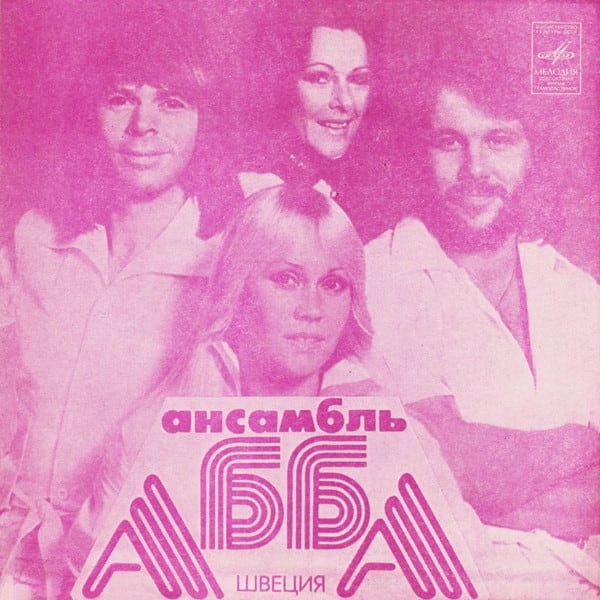
ABBA appeared in Krugozor, as did Boney M., Adriano Celentano — whose popularity in the Soviet Union is a remarkable story in itself, explored in our piece on How Italian Pop Conquered the USSR — and various other internationally known artists whose music had been licensed through official Soviet channels. The Beatles also appeared, though the story of how their music navigated Soviet censorship and eventually reached official publication is complicated enough to deserve its own treatment (and does, in our article How the Beatles Conquered the Soviet Union Without Ever Playing There). These weren't bootlegs or smuggled recordings. They were officially sanctioned inclusions, which made them both legally accessible and culturally significant — a rare moment of authorized contact between Soviet listeners and the sounds of the outside world.
The appearances were infrequent and carefully curated. Western artists did not dominate Krugozor's output. But their presence, even in small doses, gave the magazine a cosmopolitan flavor that set it apart from most Soviet publications of the era.
A Specific Issue Worth Knowing
Collectors who focus on Krugozor often point to issues from the late 1960s through the mid-1970s as the most musically interesting. During this window, the magazine balanced Soviet jazz, folk, classical, and light orchestral music alongside occasional international content, with strong visual design that reflected the optimistic graphic language of the period. Issues featuring Edita Piekha — the enormously popular Polish-born singer who became a fixture of Soviet light music — or recordings connected to the Melodiya catalog's broader output give a strong sense of how official Soviet popular taste was constructed and packaged for mass consumption.
The specific issue a collector reaches for often depends on their angle of interest. Those tracking Western music on Soviet media want the ABBA and Boney M. discs. Those interested in Soviet jazz will search for issues featuring Georgy Garanian or other prominent players from the Moscow jazz scene. And those drawn to the spoken-word and literary dimension of Krugozor will find just as rich a seam to mine.
Covers as Political Barometer
One dimension of Krugozor that rewards study beyond the audio content is the evolution of its cover design — and what that design reveals about the political and cultural climate of each period. Across nearly three decades of publication, the magazine's covers function almost as a visual timeline of Soviet ideological shifts, and for collectors, reading that timeline is part of understanding what any given issue represents.
Early issues from the mid-1960s carry the confident, forward-looking graphic energy of the Khrushchev Thaw years: bright colors, bold typography, and imagery that projected optimism and modernity. The design language of this period shared its sensibility with the broader Soviet public iconography of the era — an aesthetic of horizons and possibilities, fitting for a magazine literally named "outlook." Musicians, cosmonauts, and scientists shared cover space with a visual confidence that felt genuinely contemporary by international standards.
As the Brezhnev era took hold through the late 1960s and into the 1970s, the graphic register shifted. The period of stagnation that defined Soviet political and cultural life under Brezhnev produced a more cautious, official tone across Soviet publishing, and Krugozor's covers reflect this. The exuberant experimentation of the early issues gave way to something steadier and more conventional — competent, carefully composed, but less willing to take visual risks. The magazine still looked good by Soviet standards, but the edge of the Thaw years had softened.
By the Glasnost period of the late 1980s, the covers had opened up again. Youth culture, rock music, and a broader range of imagery found their way onto the front pages in ways that would have been unusual a decade earlier. The magazine's visual identity in these final years reflects the same loosening of constraints that was reshaping Soviet cultural life more broadly.
For collectors, this visual evolution is part of what makes Krugozor compelling as a complete artifact rather than simply a disc carrier. An issue's cover can tell you something about when it was made, what cultural anxieties or enthusiasms surrounded its production, and how its editors were navigating the always-present relationship between Soviet publishing and Soviet power. The covers deserve serious attention alongside the audio content. For a detailed visual survey of how Krugozor's design shifted across its full run, the archive at sovietrock.com offers useful documentation of the magazine's changing visual identity from its first issue to its last.
Legacy and What Survived
Krugozor ran until 1992, an almost 30-year run that carried it through Brezhnev's era of stagnation, Gorbachev's reforms, and right to the edge of the Soviet Union's dissolution. The magazine did not survive the USSR. When the Soviet state dissolved in December 1991, the institutional infrastructure that had made Krugozor possible — Melodiya's publishing apparatus, the centralized distribution network, the subsidized print runs — collapsed with it. The final issue appeared in 1992. There was no farewell edition, no commemorative retrospective. It simply stopped.
What survived was everything already in circulation. Somewhere in the region of three hundred and forty issues had been published across twenty-eight years, each containing multiple flexi discs. That amounts to well over a thousand individual recordings — folk songs, jazz performances, classical excerpts, spoken-word pieces, pop tracks, experimental compositions, field recordings — embedded in the pages of a magazine that millions of households had subscribed to. Many were thrown away. Many were damaged. But a remarkable number survived, held in attics, in bookshelves, in the collections of people who sensed, even at the time, that they were holding something worth keeping.
Today, Krugozor is sought after by collectors across the former Soviet republics, across Europe, and increasingly in the West. Complete runs are extraordinarily rare. Individual issues in good condition — with intact, unwarped discs and undamaged pages — command genuine prices. The flexi discs themselves present a preservation challenge: the format is fragile, sensitive to heat, and the grooves are shallow enough that excessive play degrades the audio quickly. Digitization efforts have been underway for years, with enthusiasts carefully transferring the audio content to preserve it in a form that will outlast the medium.
What those digitizations reveal, when you work through them systematically, is a portrait of Soviet cultural life that no other archive quite replicates. Krugozor documented what Soviet citizens were actually listening to, month by month, across nearly three decades. It carried the voices of singers who never recorded commercially, performances that existed nowhere else, music that official Melodiya releases either couldn't accommodate or chose not to prioritize. It is, in that sense, an irreplaceable document — not of what Soviet culture was supposed to be, but of what it actually sounded like.