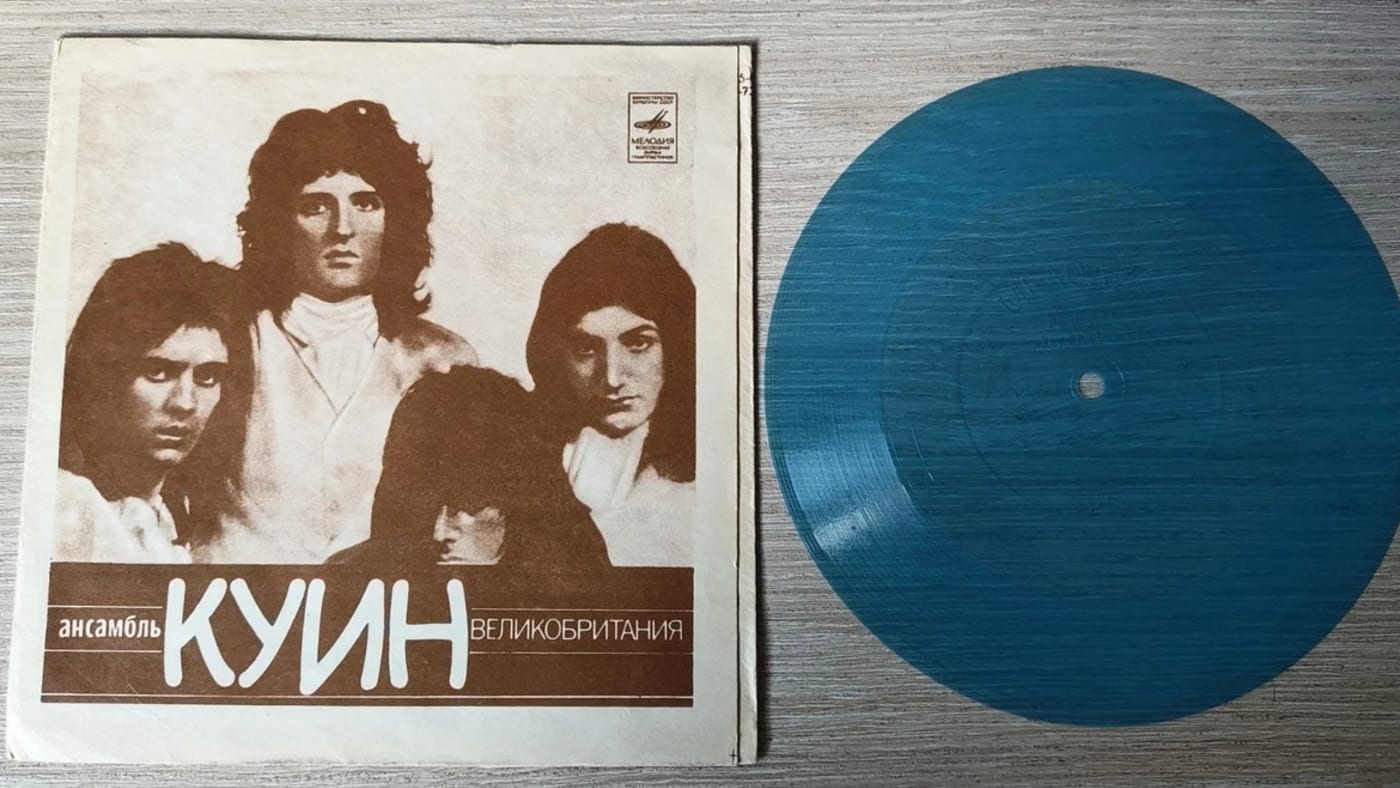
Thin as Paper, Heavy with Meaning
A flexi disc is exactly what it sounds like: a record so thin and pliable that you can bend it in half and it springs back into shape. It is cut from a single sheet of PVC plastic — sometimes just a tenth of a millimeter thick — grooved with audio that plays at 33 or 45 RPM on any standard turntable. No sleeve, no label stuck on, no weight to it. Hold one up to the light and it is almost translucent. Set it down on a record player and, against all reasonable expectation, it plays.
The format was first conceptualized in Britain in the 1950s, but it was an American company, Eva-tone Incorporated of Deerfield, Illinois, that mass-produced what it called "soundsheets" from 1962 onward. In the West, flexi discs became a clever promotional tool — tucked into magazines, mailed with cereal boxes, handed out at fast food counters. Disposable, forgettable, commercially useful for a single spin and then discarded.
The Soviet Union looked at the same object and imagined something different.
A Country Starved of Sound
To understand why flexi discs mattered so profoundly in the USSR, you first have to understand what it meant to want music there. Melodiya, the state-owned record label that held a monopoly on all recorded sound, produced pressing plant output that could not keep pace with a population of nearly 300 million people. Conventional vinyl — the kind Westerners took for granted — was expensive relative to Soviet wages, unevenly distributed across the country's vast geography, and subject to the approval of cultural authorities who decided what the public deserved to hear.
A worker in Novosibirsk or a schoolteacher in Minsk did not browse a record shop the way someone in London or New York might. Records were allocated. They were waited for. For younger listeners in particular, the gap between what they wanted to hear and what the state chose to make available was enormous, and growing wider by the late 1950s as rock and roll began filtering through from the West via shortwave radio.
This was the hunger that the flexi disc could feed — cheaply, quickly, and at scale.
The Magazine That Played Music
In 1964, a publication unlike anything in the Western world appeared on Soviet newsstands. Krugozor — the name translates loosely as "Horizon" or "Field of Vision" — was a music and culture magazine, but it came with something extraordinary bound directly into its pages: up to six flexi discs per issue, each one a playable record.
Readers did not buy Krugozor for the articles alone. They bought it to hear things. Classical performances, jazz recordings, folk music from the Soviet republics, interviews with composers, children's songs, spoken poetry — and, crucially, artists from abroad whose full albums would never receive an official Soviet release. The Beatles, Louis Armstrong, Dean Martin, and dozens of other Western artists appeared on Krugozor flexis at a time when owning their records through any other means was essentially impossible for most Soviet citizens.
The magazine's circulation climbed to over a million copies per issue at its peak — staggering figures for a publication built around a format the West had largely abandoned to cereal box promotions. Krugozor ran from 1964 until 1992, spanning nearly the entire late Soviet era, and it functioned as something the USSR otherwise lacked: a regular, legal, affordable mechanism for distributing recorded music to ordinary people.
Did You Know? Each issue of Krugozor contained up to six flexi discs alongside just sixteen pages of printed content — meaning the music was always the point, and the magazine existed to carry it.
Learning by Listening
Krugozor was far from the only publication to recognize what the flexi disc format could do. Across the Soviet publishing world, educational institutions, scientific journals, children's publishers, and language-learning organizations began incorporating playable records into printed material with an enthusiasm that had no parallel anywhere in the Western publishing industry.
Language courses sent flexi discs to students learning English, French, or German — the record carrying the pronunciation exercises the printed page could not teach. Science magazines included recordings of natural phenomena: whale calls, bird song, recordings made aboard spacecraft. Children's publications — recognizing that a child who could spin a record was a child who would beg their parents to subscribe — issued story records, sing-along discs, and educational audio that turned passive reading into something closer to radio.
Kolobok, the beloved Soviet children's magazine, issued flexi discs with fairy tales and songs read aloud by some of the most recognizable voices in Soviet broadcasting. For children growing up in the 1970s and 1980s, the moment of carefully placing a flimsy Kolobok flexi onto the family turntable was a small but genuine ritual — a first encounter with the idea that a physical object could carry something as alive as a voice.
The Underground It Enabled
The legal universe of Soviet flexi discs existed alongside a shadow economy of unofficial sound. Readers who understood that a flexi disc was simply grooved PVC plastic figured out — not always legally — that the same principle could be adapted. The earlier phenomenon of roentgenizdat (as explored in Music on Bones: The Incredible Story of Soviet X-Ray Records), in which bootleg recordings were cut onto discarded medical X-ray film, was the immediate predecessor to a broader underground culture of improvised duplication.
Flexi discs, with their low cost and ease of reproduction, became part of that culture. Unofficial pressings of forbidden artists circulated through networks of collectors and enthusiasts — the stilyagi subculture, the underground jazz devotees, the early rock fans who passed recordings from hand to hand the way samizdat literature traveled through dissident circles. The format's very disposability was, paradoxically, a kind of protection: a flexi disc was easy to hide, easy to destroy if necessary, easy to explain away.
This dual life — official publication vehicle and underground currency — is unique in the history of recorded formats. No other country produced a format that operated simultaneously as a state-approved educational tool and a vector for music the state was actively trying to suppress.
Bulat Okudzhava and the Voice the State Couldn't Quite Silence
No single figure better captures the tension at the heart of Soviet flexi disc culture than the singer-songwriter Bulat Okudzhava. A poet, novelist, and performer whose gentle guitar ballads — avtorskaya pesnya, or "author's song" — circulated on unofficial magnitizdat tape recordings long before they appeared on any official medium, Okudzhava occupied a complicated position in Soviet cultural life: too popular to suppress entirely, too honest to promote without reservation.
To understand why Okudzhava matters specifically to the history of the flexi disc, it helps to understand what magnitizdat was and what it could not do. Homemade tape recordings of Okudzhava's performances passed from hand to hand across the Soviet Union throughout the 1960s, copied and recopied until the quality degraded almost beyond recognition. This was how his audience found him — not through any official channel, but through a chain of trust and shared risk. The recordings existed outside the state entirely, which meant they could vanish just as easily as they spread.
The flexi disc changed that equation. When Okudzhava began appearing on Krugozor flexis in the late 1960s and 1970s, something significant shifted: his voice moved from the underground into a state-sanctioned format, printed and distributed to over a million subscribers per issue. This was not a straightforward victory for artistic freedom. It was the result of careful, often opaque negotiation between editors, cultural officials, and the artists themselves — a process in which certain songs were deemed acceptable while others remained unpublishable. A Krugozor flexi might carry one of Okudzhava's gentler, less politically freighted ballads while his more pointed work stayed quietly out of reach.
What made this so significant for listeners was precisely the visibility of that line. When a Krugozor issue arrived in the post featuring Okudzhava, subscribers were receiving not just a song but a piece of evidence — proof that the boundary between official and unofficial culture was permeable, that the state's control over what could be heard was real but not absolute. For many listeners, a flexi disc of Okudzhava was their first legitimate encounter with an artist they had previously known only through degraded tape copies passed in secret. The object itself — thin, cheap, bound into a magazine — carried an almost disproportionate weight because of what it represented: the state acknowledging, however partially and reluctantly, a voice it had never fully managed to silence.
Okudzhava's flexi appearances also had a practical consequence for collectors. Because his officially sanctioned recordings were so selectively chosen, the Krugozor issues featuring him function today as a kind of documentary record of which songs the Soviet cultural apparatus was willing to tolerate at any given moment. Tracing his appearances across the magazine's run tells you something not just about his career but about the shifting calculations of Soviet censorship across two decades.
The flexi disc, in this sense, was a messenger carrying more than it was supposed to.
What the Format Left Behind
Krugozor ceased publication in 1992, a casualty not of any political decision but of the economic collapse that followed the Soviet Union's dissolution. Cheap cassettes and then CDs made the flexi disc obsolete almost overnight. The infrastructure that had supported the format — the pressing technology, the magazine distribution networks, the institutional enthusiasm for bound-in audio — vanished within a few years, and with it went a publishing culture that had been genuinely without equivalent anywhere in the world.
What remained was the records themselves. Tens of millions of flexi discs, tucked inside old magazines in dachas and apartment blocks, inherited without context, stored in drawers alongside photographs and letters. Unlike the pressed vinyl of the Melodiya catalog — which is explored in depth in Understanding Soviet Record Labels — Soviet flexi discs had no obvious value to anyone at the time. They were not collected. They were kept, which is not quite the same thing.
It is partly that accidental survival that makes them fascinating to researchers today. A Krugozor issue from 1967 containing a Western artist who never received a full Soviet release represents a documented moment of cultural negotiation — proof of what was allowed, and by whom, and when.
Why Collectors Look East for Flexis
The global collector market for flexi discs has grown quietly but steadily, driven partly by a broader vinyl revival and partly by a genuine recognition that Soviet pressings occupy a unique position in the history of recorded sound. The flexi discs produced for Krugozor and other Soviet publications are sought after for multiple overlapping reasons: their visual design, which carries the bold graphic language of Soviet print culture; the music they contain, which in many cases exists in no other official recorded form; and their historical resonance as objects that traveled through a censored society doing more than their creators intended.
Condition is everything with flexi discs. The PVC degrades over time, and decades spent folded inside old magazines have left many examples with creases, warps, or surface noise that affects playback. Clean, unplayed examples — particularly from the early Krugozor years, 1964 through the early 1970s — are the most desirable. Issues containing Western artists are consistently the most sought after, and any issue featuring a full complement of all six flexis, still intact and unplayed, commands a meaningful premium.
The wider context of Soviet music collecting — the pressing variants, the regional label differences, the relationship between Melodiya and its republic subsidiaries — is covered in more detail across The Story of Melodiya and the Krugozor archive feature here on East of the Groove.
For Collectors
What to look for: Complete Krugozor issues with all flexis intact. Early issues (1964–1972) are rarer and generally more valuable. Look for issues featuring Western artists — the Beatles, jazz musicians, or any non-Soviet performer listed on the cover — as these attract the most collector interest.
Condition notes: Hold each flexi up to the light before purchasing. Hairline creases across the playing surface are common and will cause skipping. Edge damage is less critical. The printed surface of the disc itself — Krugozor flexis often had the magazine's distinctive graphic design printed directly onto the playing side — should be legible and unfaded.
Where to find them: Ukrainian and Russian sellers on eBay and Discogs are the most consistent source. Estate sales and flea markets in Eastern Europe remain productive hunting grounds for complete issues. Beware of incomplete issues sold as complete — missing flexis are common, and a Krugozor without its discs is a magazine, not a record.
Why they matter: A Soviet flexi disc is one of the few objects in music collecting that is simultaneously a record, a piece of graphic design, a publishing artifact, and a document of cultural history. You are not simply buying a record. You are buying a window into a moment when music moved through a society in ways its guardians did not fully control — thin as paper, and surprisingly hard to silence.
Collector's Tip: When playing a flexi disc for the first time, place a small coin on the headshell of your tonearm to add a little extra tracking weight. The lightweight cartridge pressure that works perfectly for conventional vinyl is often not enough to keep the stylus in the groove of a flimsy flexi.