МАШИНА ВРЕМЕНИ (MASHINA VREMENI)
В Добрый Час (Good Luck)
FAIXAS
4.08 / 5
LADO A
LADO B
SOBRE ESTE DISCO
THE ALBUM
В Добрый Час (Good Luck) is a studio album by Mashina Vremeni that arrived at a pivotal moment in Soviet rock history — its official Melodiya release in the early 1980s marked one of the first times a genuine Soviet rock act had been granted legitimate state-label distribution for original material. The sound is melodic rock built on clean electric guitars, steady rhythm work, and strong vocal hooks, sitting somewhere between the accessible end of Western rock and the Russian bardic tradition. Lyrically the album deals in allegory and oblique commentary — a necessity given censorship pressures — with imagery of roads, journeys, chance, and moral choice threading through the songs. The writing is sharp enough that the metaphors hold up as poetry independent of their evasive function. For Soviet listeners who had spent years circulating samizdat tape recordings of the band, hearing this material on a pressed, legally available record was itself a significant event. The album is not heavy or experimental — it is melodic, well-crafted, and deliberately accessible, which is partly why it got through the approval process and partly why it connected so widely.
ARTIST & RECORDING CONTEXT
Mashina Vremeni (Time Machine) formed in Moscow in the late 1960s and became one of the defining bands of the Soviet rock underground. By the time В Добрый Час was recorded, the group was centered on Andrei Makarevich as primary songwriter, vocalist, and guitarist, with a stable lineup that had been refined through years of unofficial concert performance. Makarevich's songwriting carries the album — his lyrics are the reason the record matters as much as the music does. Tracks like "Она идёт по жизни смеясь" demonstrate the band's gift for melody that feels effortless without being thin, while the title track and surrounding material show how they balanced rock energy with the kind of reflective introspection that connected to the Russian literary and song tradition. The production, handled within the Soviet state recording infrastructure, is clean and relatively restrained compared to the rawer live recordings that had circulated on tape — the arrangements are tighter, the sound more polished, which gave the album a different character than what fans knew from the underground circuit.
THIS PRESSING
This is the official Soviet Melodiya pressing — the state label that held a monopoly on recorded music production and distribution in the USSR. For Mashina Vremeni, a Melodiya release was not a straightforward commercial transaction but a negotiated outcome: the band had existed for years in a grey zone, performing without official status, with their music spreading through the magnitizdat tape network rather than through any sanctioned channel. The Melodiya edition of В Добрый Час was issued in the standard Soviet format — a single LP in a printed sleeve — and distributed through the state retail network, the Melodiya shops and general consumer outlets that reached across the Soviet Union. The tracklist reflects what passed through the approval process, meaning the more pointed material that circulated on unofficial recordings may not appear here in identical form. The pressing quality is typical of Soviet vinyl production of the period — functional rather than audiophile, pressed on domestic compound that varies in quality across copies.
COLLECTOR SIGNIFICANCE
Within the USSR, В Добрый Час was received as a landmark — not because Soviet audiences were unfamiliar with Mashina Vremeni, but because official recognition changed the meaning of the music. Fans who had been passing tapes hand to hand for years could now buy a record openly, and the album sold in large numbers through the state distribution system. That wide distribution is a double-edged fact for collectors: the pressing is not rare by scarcity, but finding a copy in genuinely good condition is harder than the large run might suggest, because Soviet vinyl was pressed on soft compound that wears quickly and was often handled without care. What makes this pressing collectible today is its historical position — the moment of official legitimization documented in physical form — combined with the practical reality that the Soviet domestic pressing is the correct artifact for anyone collecting Soviet rock as a Soviet cultural phenomenon rather than as a variant of Western rock. Melodiya sleeves from this period also have a distinct graphic character, and the typography and design language of the Soviet state aesthetic give the object a visual identity entirely separate from any Western equivalent.
- В Добрый Час — the title track sets the album's tone of open-road optimism filtered through careful, non-confrontational phrasing that could pass censorship while still reading as personal and genuine.
- Она идёт по жизни смеясь — one of the band's most enduring melodic pieces, built on a guitar line that anchors Makarevich's lyrical portrait of uncomplicated joy.
- Синяя птица — uses the Russian folkloric image of the blue bird of happiness to carry the album's recurring theme of searching for something just out of reach, wrapped in a clean, mid-tempo rock arrangement.
Reparaste nalgum erro ou em algo que precise de correcção? Contacta-me — adorava saber.
PODERÁ TAMBÉM INTERESSAR-TE

Машина Времени (Mashina Vremeni)
Музыка Под Снегом (Music Under The Snow)
Vinyl, 7", 45 RPM, Single · USSR · 1986

Riccardo Fogli
Collezione
Vinyl, LP, Compilation · USSR · 1984
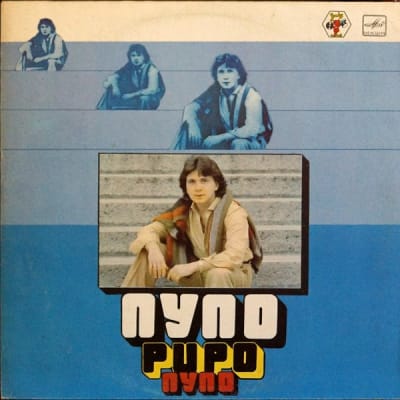
Pupo
Pupo (Пупо)
Vinyl, LP, Album · USSR · 1985

Ricchi E Poveri
Ricchi e Poveri
Vinyl, LP, Album, Reissue · USSR · 1986

Adriano Celentano
Поет Адриано Челентано (Sings Adriano Celentano)
Vinyl, LP, Album, Repress · USSR · 1987

Mireille Mathieu
Любовь и Жизнь (Love and Life)
Vinyl, LP, Album, Repress · USSR · 1979