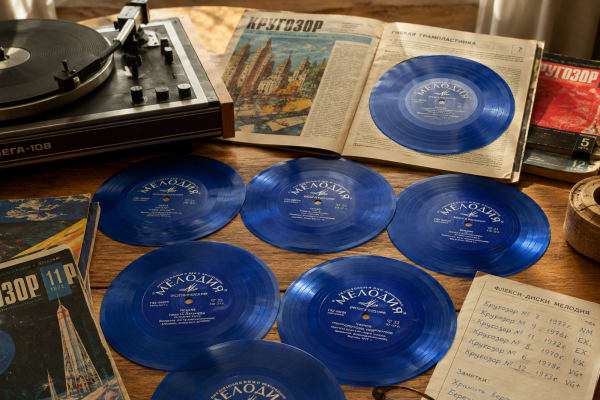
You're standing at a flea market table somewhere in Eastern Europe, or maybe you just pulled something out of a dusty crate at an estate sale. The record in your hands has Cyrillic text, a colorful label design, and a string of numbers and letters that mean absolutely nothing to you - yet. Don't put it down. That label is actually packed with information — you just need to know how to read it. This guide will walk you through everything printed on a Soviet record, from the catalogue number to the pressing plant code, so you can start making sense of what you're holding before you even get home.
The Anatomy of a Soviet Record Label
The first thing most people notice is the label design itself. Soviet records released under Melodiya — the state monopoly that handled virtually all official music releases in the USSR — went through several distinct visual phases. If you'd like to read more about Melodiya's story, click here.
Early labels from the late 1950s and 1960s tend to have simpler, more utilitarian layouts. By the 1970s and into the 1980s, you start seeing the more recognizable designs: the classic blue-and-silver label, the rainbow striped label, the later orange-and-red variations. Label design can give you a rough era at a glance, but it is a starting point, not a definitive answer.
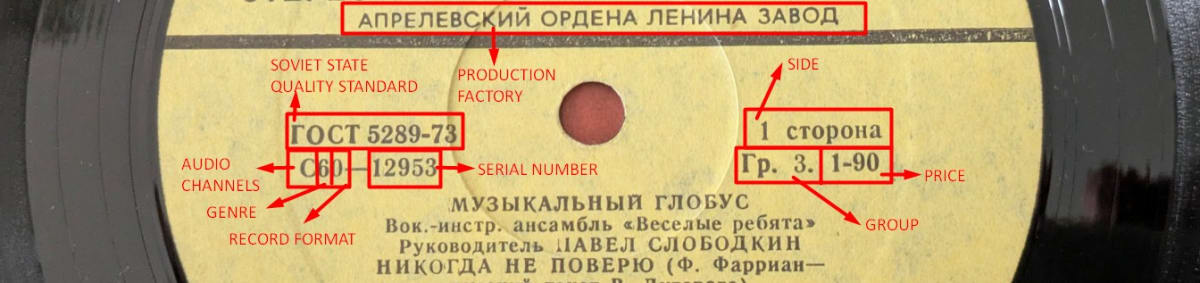
The center of the label usually features a series of "codes" that every record collector should understand. Two intersecting rings combined with the word "stereo" denote a stereophonic recording, while a triangle denotes a mono recording. The numbers "33" and "45" represent the nominal rotation speed of the records—the number of revolutions (rounded) per minute. See below.

The catalogue number, which almost always appears prominently on the label, follows a specific logic. A typical number might look something like С 60—05349-50 or М 60—05351-52.
That first letter is crucial: С (which looks like a C but is the Cyrillic letter for the Latin alphabet letter "S") and it stands for Stereo (Стерео). М stands for Mono (Моно). There is also a third prefix worth knowing: starting in 1982, Melodiya began releasing records prepared from digital recordings, and those pressings introduced the letter А on their labels. On stereo records released before 1980, you'll also see the designation СМ rather than simply С. This indicates the record was cut with a limitation on the vertical component of the stereo signal — a compatibility measure that allowed the record to be played on older mono equipment with limited vertical stylus compliance, without the needle jumping the groove. Records pressed from matrices made during that era are still being reissued with the СМ designation today.
Following the audio channels indication, the first digit indicates the genre of the recording:
- 0 - hymns, documentaries, socio-political recordings;
- 1 - symphonic, operatic, choral music;
- 2 - Russian folk music;
- 3 - Creative works of the peoples of the USSR;
- 4 - Poetry, prose, drama;
- 5 - Children's recordings;
- 6 - Pop music, songs of Soviet composers, jazz, operetta;
- 7 - Educational recordings (lessons, lectures, phono-readers, etc.);
- 8 - Music of the peoples of foreign countries (folklore);
- 9 - Other recordings (special orders "Krugozor," "Kolobok," measuring records, etc.).
The second digit indicates the record format: 0 - 300 mm (giant), 1 - 250 mm (grand), 175 mm (mini). This is followed by a five-digit serial number. The record side numbers have three more digits. This additional code allows for the computer processing of orders from retail organizations for discs. For example, Alexander Malinin's album "The Restless One," released by the Aprelevka Plant in 1990, has the index C60 30343 006: stereophonic recording, pop genre, 300mm record format, serial number 30343 (on the reverse side: 30344), and the code for retailers is 006.
Elsewhere on the label, you'll typically find the side (сторона) number — 1 and 2 on a single LP, or 3, 4, and so on across a multi-disc album. Below that appears the repertoire group designation, Group 3 (Гр.3), for example, covered operetta, pop, and dance music. (Group 1 - documentary, socio-political recordings; Group 2 - symphonic, opera, chamber, literary and dramatic recordings, music of the peoples of the USSR and foreign countries, children's recordings, etc.).
The price of the record without packaging appeared alongside that group designation (Гр.3. 1-90)
On one of the sides of the label, you might also find the GOST (ГОСТ) standard designation — the Soviet state quality standard applicable to records. Records issued after 1988 conform to GOST 5289-88, which set higher technical parameters than earlier standards.
Soviet labels often included more production detail than Western equivalents of the same era — ensemble or artist name, individual track titles, composer credits, sometimes the recording engineer or producer — which is genuinely useful for collectors trying to date a pressing or verify what's actually on the record.
Pressing Plants and How to Identify Them
One of the most important pieces of information on a Soviet record label is the pressing plant name, which typically appears on the upper part of the label, right beneath the Melodiya logo. This is where you should look first when trying to identify who manufactured a particular copy.
The four main plants you'll encounter are:
- Aprelevka (Апрелевский завод) — located outside Moscow, this was the largest facility and its pressings are generally the most common.
- Riga (Рижский завод) — located in Latvia, the Riga Record Factory is widely regarded as having produced the best quality pressings, particularly for classical and jazz releases. The vinyl tends to be quieter, the pressings flatter, and the overall quality control noticeably higher. If you find two copies of the same album and one shows the Riga plant name on the label, that's the one to take home.
- Leningrad (Ленинградский завод) — a mixed bag depending on era.
- Tashkent (Ташкентский завод) — located in Uzbekistan, Tashkent pressings are rarer and therefore sometimes more collectible on that basis alone, but they are not typically known for pressing quality.
Learning to identify which plant pressed a given copy is one of the most important skills you can develop as a Soviet record collector, because two copies of the same release can vary enormously in sound quality based on nothing other than where they were manufactured.
Why Two Copies of the Same Album Can Look Completely Different
This trips up almost every collector who's new to Soviet records. You find a copy of, say, Abba pressed by Melodiya — the USSR released licensed pressings of Western pop acts including ABBA and Italian artists like Adriano Celentano — and then you find another copy of the same release at another stall, and it has a different label color, a different sleeve design, and different text on the label. Are they different albums? No. They're just different pressings of the same release.
Because Melodiya operated across multiple pressing plants over decades, the same catalogue number could be manufactured at different facilities at different times, sometimes using different label designs and sometimes with updated sleeve artwork. Runs would be repressed as demand warranted, and between pressings, label templates were revised, sleeve designs were updated, or production was shifted from one plant to another. It was a centrally planned system, but that didn't mean it was consistent. Add in the fact that Soviet records were frequently exported under a separate export edition program — distributed in the West through a company called Melodiya/HMV, or through regional licensed arrangements — and you have multiple legitimate versions of the same record looking quite different from one another. Export editions often have slightly different label text, sometimes including English-language information alongside Cyrillic, and occasionally come in higher-quality sleeves aimed at Western retail markets.
If you ever want to go deeper on how Melodiya itself was organized and what drove these production decisions, the site's dedicated Melodiya history article covers that ground in detail. For our purposes here, the key practical takeaway is: never assume two copies are the same just because they share a catalogue number, and never assume they're different just because they look different.
Identifying Export Editions and Licensed Western Releases
Export editions deserve their own moment of attention because they confuse new collectors constantly. When the Soviet state wanted to earn hard currency in Western markets, Melodiya records were exported and sometimes licensed to Western labels for local distribution. These pressings were often made to a higher standard — better vinyl, better quality control — and the labels sometimes include additional text in Latin script. If you find a Soviet pressing with both Cyrillic and English on the label, or a barcode on the sleeve (which became more common in the 1980s), you may well have an export edition.
Licensed Western releases of Soviet repertoire, particularly classical music, were sometimes pressed in the West entirely — meaning the physical record was not manufactured in the USSR at all, but the licensing originated from Melodiya. These are technically not Soviet pressings even if the music comes from Soviet recordings. Pay attention to where the pressing credit appears on the label to determine where the vinyl was actually made. A copy of a Soviet symphony pressed at a UK or German plant is a different artifact from a copy pressed at Aprelevka, and depending on what you're collecting, that distinction matters.
Common Mistakes New Collectors Make
The biggest one: assuming every Melodiya record is rare and therefore valuable. Melodiya pressed millions of records across decades. The Soviet state needed to supply music to an enormous population, and pressing runs could be massive. Classical music, folk music, and officially approved pop were produced in huge quantities. Common releases are common. Rarity, when it exists, usually comes from something specific: a very early pressing of a significant release, a record from a smaller regional plant, an export edition in particularly good condition, or a genuine anomaly like an unauthorized recording that slipped through before being recalled.
Mistake number two: ignoring the plant name on the label. New collectors often look at the catalogue number and the sleeve and stop there. The pressing plant identification printed beneath the Melodiya logo is where some of the most useful information lives. Get in the habit of checking it on every record before you make a decision.
Third: assuming label design alone tells you when a record was made. Labels were reprinted and reused across different eras, and pressing plants didn't always update their label stock simultaneously. An early-looking label design doesn't guarantee an early pressing. Cross-reference the plant name with the catalogue number format and the sleeve design before drawing conclusions about age. And finally, don't assume all Soviet pressings of the same record sound the same. They don't. That Riga pressing matters.
For Collectors — What to Look For and Why It Matters
If you're buying Soviet records with any seriousness, build your eye for the details that actually move the needle. Condition is paramount, as it is with any vinyl, but Soviet records present some specific challenges: they were often stored in paper inner sleeves without much care, and the sleeves themselves — printed on thinner stock than Western equivalents in many cases — are frequently damaged independent of the record's condition. A Soviet LP in a clean sleeve with an intact label is worth more than the grading alone suggests.
For pressing quality, prioritize Riga if you're chasing sound. For historical significance and rarity, earlier Aprelevka pressings of key releases — Soviet jazz from the 1960s, certain classical recordings conducted by names like Yevgeny Mravinsky, early rock-adjacent material — are the ones that serious collectors track down. Export editions in clean condition are undervalued in some markets and fairly sought-after in others, so regional pricing varies a lot. If you find a Soviet pressing of a licensed Western pop act — ABBA, Boney M, various Italian and French artists who had licensing arrangements with Melodiya — those records have a dedicated collector base of their own, separate from the Soviet music enthusiast crowd.
When you pick up that unfamiliar record at a flea market, take thirty seconds to do this: read the catalogue number prefix (С, СМ, М, or А), note the full number sequence, look beneath the Melodiya logo for the pressing plant name, check the label design for rough era, and look at the sleeve for any Latin script or export markings. In thirty seconds you've already built a profile of what you're holding. Every Soviet record has a story threaded through its label, its catalogue number, and its pressing history. Learning to read those details is where collecting stops being a guessing game and starts becoming something much more rewarding.