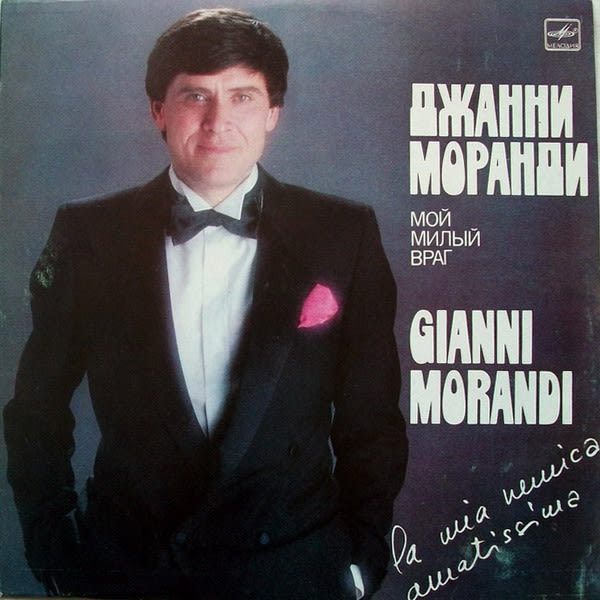
There is a moment, somewhere in the mid-1980s, that probably repeated itself in thousands of Soviet apartments from Tallinn to Tashkent. Someone drops a needle on a Melodiya pressing. A melodic, slightly melancholy voice fills the room. The lyrics are in a foreign language — not English, not French — and yet there is something in the phrasing, the drama, the warmth of it that feels almost familiar. The record is by Toto Cutugno, or maybe Al Bano & Romina Power, or Pupo. And the listener, who has never been to Italy and likely never will, feels a sudden, inexplicable sense of connection. This is not a Cold War story about smuggled contraband or underground dissent. This is a story about how a whole country fell in love with Italian pop, and about the surprisingly tangled political, cultural, and human reasons why that happened.
A Peculiar Geopolitical Opening
The relationship between the Soviet Union and Italy was never straightforward, but it was real, and it ran deeper than most people realize today. Italy had the largest Communist Party in Western Europe — the Partito Comunista Italiano, or PCI — and at its peak in the 1970s it commanded around one-third of the Italian vote. This was not a fringe movement. It had mass membership, trade union muscle, and genuine intellectual credibility. Gramsci was Italian, after all. The PCI maintained warm, if sometimes complicated, ties with Moscow, and this political alignment had a quiet but concrete effect on cultural exchange. Soviet cultural authorities were far more relaxed about Italy than they were about the United States or Britain. Italy was, in a sense, a friendly country — or at least a country with a powerful friendly faction inside it.
This meant Italian artists could tour the Soviet Union in ways that were simply off the table for their American counterparts. It meant Italian films were screened widely in Soviet cinemas. Federico Fellini was a celebrated figure in the USSR. Sophia Loren was a household name. By the time Italian pop music began arriving on Soviet shores in earnest in the late 1960s and accelerating through the 1970s, it was landing in cultural soil that had already been prepared. Soviet audiences knew Italy existed as something other than a capitalist enemy. They knew it as a place of art, beauty, drama, and — crucially — as a place where workers voted Communist.
There is a further irony worth noting. While the Soviet state was deeply suspicious of rock and roll — British and American rock was seen as decadent, subversive, and tied to a hostile ideological project — Italian pop occupied a different category. It was melodic, emotionally direct, and rooted in a tradition of song that Soviet cultural gatekeepers could recognize and accept. A song about love and longing, sung with enormous vocal drama over an orchestral backing, was not threatening. It was, in fact, not so different from the Soviet estrada tradition. That was the key that unlocked the door.
The Artists Who Came to Stay
Adriano Celentano arrived first, in spirit if not always in vinyl form. His music had been circulating in the Soviet Union since the early 1960s, partly through bootleg reel-to-reel tape recordings — the legendary magnitizdat culture that also sustained Vysotsky and Galich. Celentano was something of an anomaly: an Italian rock and roller who moved like Elvis but sang in a language that sounded vaguely like Spanish to Soviet ears. His 1961 nonsense-syllable track Prisencolinensinainciusol — a song that consisted of sounds designed to mimic American English without actually being English — became a cult item in the USSR for reasons that make complete sense once you think about it. Here was someone making fun of American cool, dismantling it, turning it into pure rhythm and absurdity. Soviet audiences found that deeply satisfying.
But the artists who truly conquered the mainstream were the ones who arrived a decade or so later, when Melodiya got seriously involved. Al Bano & Romina Power were huge — their combination of operatic passion and clean romantic sentiment was almost tailor-made for the Soviet emotional register. Felicità, released in 1982, was everywhere. Toto Cutugno's L'Italiano, with its nostalgic, almost folk-like simplicity, connected in ways that felt almost mysterious given how specific its subject matter was. Here is a song that is essentially about being Italian — about espresso and old churches and the smell of specific Italian things — and yet Soviet listeners in Novosibirsk and Kiev and Minsk heard something universal in it and claimed it as their own. Ricchi e Poveri brought a softer, more radio-friendly sound that worked well on Soviet state television. Pupo, perhaps best known in the West for Su di noi and Gelato al cioccolato, developed a following in the USSR that dramatically outlasted his commercial peak in Italy itself.
What is worth emphasizing here is that these artists were not obscure in Italy — they were mainstream pop stars. But in the Soviet Union they became something more than that. They became, for many listeners, the sound of a certain kind of emotional freedom. The music was passionate in ways that Soviet pop, with its ideological weight, often was not. You could listen to a Toto Cutugno record and feel something without feeling watched.
Melodiya's Strange Role as Cultural Broker
The state record label Melodiya had a peculiar dual function. On one hand, it was a tool of cultural control — it decided what Soviet citizens could hear, and its gatekeeping was real. On the other hand, it was also, by the late 1970s, a surprisingly efficient channel for bringing Western music into Soviet homes — provided that music could be framed in acceptable ways. Italian pop fit that framing almost perfectly.
Melodiya licensed and pressed Italian records in significant quantities throughout the late 1970s and 1980s. These pressings were not always high quality — Soviet vinyl was notoriously inconsistent, and Melodiya releases varied wildly from plant to plant — but they were affordable and widely distributed. A Toto Cutugno LP on Melodiya might cost the equivalent of a few hours of average Soviet wages. That accessibility mattered enormously. This was not music for a black-market elite; it was music that a factory worker in Minsk or a schoolteacher in Tbilisi could buy at their local music store.
The label also brought Italian artists to the Soviet Union for live performances, and these concerts were events of genuine social significance. When Al Bano & Romina Power performed in Moscow, they were not playing to a niche audience of cosmopolitan intellectuals. They were playing to ordinary Soviet citizens for whom this was, in many cases, the first time they had ever seen a Western performer in person. The photographs from these concerts — the audiences, the expressions — are striking. There is something in those faces that goes beyond entertainment.
Did You Know? Toto Cutugno performed at the 1987 Eurovision Song Contest and won, representing Italy with Insieme: 1992 — a song about European unity. He later became enormously popular across the former Soviet Union, particularly in Russia and Ukraine, where he continued performing to sold-out venues well into the 2000s. In Italy, his star had faded considerably by then. The USSR effectively gave him a second career.
What Soviet Ears Were Actually Hearing
To understand why Italian pop connected so deeply, you have to understand something about the Soviet emotional landscape. Soviet popular culture — the estrada tradition — had real emotional richness, but it operated within constraints. Songs about love were acceptable, but they tended toward a certain restraint, a certain propriety. Italian pop, by contrast, was operatic in its emotional directness. Al Bano could go from a whisper to a full-throated bellow within a single bar. There was nothing restrained about it. And yet it wasn't threatening in the way that rock was threatening. It wasn't about rebellion. It was about feeling things very intensely, which is something Soviet audiences were more than ready to do.
There was also a language factor that worked in Italian pop's favor in an unexpected way. English — the language of American and British rock — carried ideological baggage. It was the language of the enemy, or at least of a rival civilization. Italian, by contrast, was heard as a beautiful, harmless, almost musical language in itself. Soviet listeners often could not understand a word, but the sound of Italian was pleasurable. It felt romantic and cinematic rather than foreign and suspicious. Many Soviet listeners who grew up in this era will tell you they simply assumed the songs were about love and beauty and yearning — which, generally, they were. The lack of comprehension was actually a kind of freedom. The music meant whatever you needed it to mean.
Did You Know? Ricchi e Poveri — the Italian duo of Angelo Sotgiu and Angela Brambati — became so famous in the former Soviet Union that they continued touring Russia and the CIS countries decades after their Italian popularity had peaked. As recently as the 2010s, they were headlining large concerts in Russia, often to audiences who knew every word of songs their Italian contemporaries had largely forgotten.
For Collectors
Soviet-era Melodiya pressings of Italian pop artists are genuinely interesting objects, and the collecting market for them has been growing steadily, particularly in Russia, Ukraine, the Baltic states, and among diaspora communities worldwide. Here is what you need to know before you start hunting.
Condition is everything, and it is rare. Melodiya vinyl was pressed to varying quality standards depending on which plant produced it — the Moscow plant, the Leningrad plant, and regional facilities all had different reputations. Records were sold cheaply and played often. Finding a Melodiya pressing of a Toto Cutugno or Al Bano album in truly excellent condition is not trivial. When you do find one, the price has been climbing.
Look for the flexidiscs. Melodiya produced flexi records — thin, playable plastic discs, sometimes included with the magazine Krugozor — and Italian pop artists appeared on these with some regularity. These are delightful, fragile, and increasingly sought after. A Krugozor flexi featuring Adriano Celentano from the late 1960s or early 1970s is a legitimate piece of Cold War cultural history. They are also, frankly, wonderful to hold.
The compilation albums are undervalued. Melodiya released a number of anthology-style compilations under titles like Estrada Italii (Italian Variety) that bundled tracks from multiple artists onto a single LP. These were often the primary way Soviet listeners encountered Italian music in one sitting, and they function today as fantastic time capsules. The artwork on these compilations is often simple but distinctive — very much of its era.
Country of origin matters to some buyers. A pressing manufactured in Italy and somehow acquired in the Soviet era has a different story attached to it than a Melodiya domestic press. Original Italian pressings of Toto Cutugno's L'Italiano or Al Bano & Romina Power's Felicità that circulated in the USSR via unofficial channels — through sailors, diplomats, traveling musicians — carry an extra layer of provenance that some collectors actively seek. These are harder to verify, but when the story is genuine, they are remarkable artifacts.
Pupo is slept on. In current collecting circles, Pupo's Melodiya-era pressings are less aggressively priced than Celentano or Al Bano material, which makes now a reasonable time to pick them up. His Soviet fanbase was genuine and large, and awareness of his catalog is growing in the West.
The Echo That Did Not Fade
The legacy of Italian pop in the former Soviet space is not a nostalgic footnote. It is an active, living presence. Tribute concerts, radio programming dedicated to Italian classics, and streaming playlists built around this exact repertoire continue to attract audiences in Russia, Ukraine, Belarus, the Baltic states, and Central Asia. For a generation that grew up in the late Soviet period, these songs are not foreign imports — they are part of the emotional furniture of a life. They are what was playing when something important happened. They are tied, for millions of people, to memory in the way that only music can be tied to memory.
There is something genuinely moving about that. A song like Felicità was written by an Italian singer-songwriter in the early 1980s, intended for an Italian audience, rooted in specifically Italian cultural references. And yet it became, through a chain of political accidents, commercial decisions, ideological calculations, and plain human hunger for beauty, the soundtrack to someone's childhood in Kharkov or someone's wedding in Almaty. That kind of transnational emotional migration is what makes record collecting — and music history — worth pursuing. The grooves carry more than sound. They carry the whole strange story of how the world actually worked, under the surface of the official version.