Снова В СССР (Back In The USSR)
PISTAS
3.70 / 5
CARA A
CARA B
SOBRE ESTE DISCO
THE ALBUM
Eleven rock and roll covers recorded in two days — that is the entire proposition of Снова В СССР. The album is a raw, unadorned studio session built from songs McCartney loved before The Beatles existed: Little Richard, Fats Domino, Eddie Cochran, Carl Perkins, and others who defined American rhythm and blues and early rock and roll in the 1950s. There are no overdubs, no production sheen, no attempt to update the material. Tracks like "Люсиль" (Little Richard's "Lucille") and "Канзас-Сити" ("Kansas City," a Leiber-Stoller standard) are played close to their source recordings, with the looseness of a band that cut everything quickly and kept the energy rather than the polish. The result sits somewhere between a rehearsal tape and a jukebox — informal in the best possible sense. What made it historically significant was not the music itself but the decision to release it exclusively in the Soviet Union in 1988, making it the first album by a Western artist issued solely for that market. The gesture carried genuine weight during late perestroika, when Western popular music remained tightly controlled and a record like this, arriving through official state channels, was an extraordinary event.
ARTIST & RECORDING CONTEXT
Paul McCartney recorded the album in a deliberate retreat from the polished, heavily produced sound of his 1986 LP Press To Play, which had received a cool critical reception. Wanting to strip back to the music that had shaped him before his career with The Beatles, he hired three session musicians — the lineup kept intentionally small — and booked two days of studio time. The sessions were highly productive: 22 songs were recorded in total, with 13 making the final album and others, including a cover of "I Saw Her Standing There," left in the vault. The tracklist draws heavily on American rock and roll and R&B classics. "Все В Порядке, Мама" is "That's All Right (Mama)," the Elvis Presley debut. "Ах, Какой Стыд" is "Ain't That a Shame," the Fats Domino song. "Ночной Экспресс" renders "Twenty Flight Rock" — Eddie Cochran's song, famously the track McCartney played for John Lennon at their first meeting in 1957 — which gives the album a quietly personal dimension beyond its surface simplicity. McCartney described the record as an acknowledgment of Soviet fans who had followed his music and The Beatles from the beginning, framing it explicitly as a gesture of cultural friendship during a period of political thaw.
THIS PRESSING
This is the original and, at the time of release, only pressing of the album — Melodiya issued it in 1988 under catalogue number А60 00415 006, exclusively for the Soviet market. Pressed at one of Melodiya's regional plants, this LP appeared before any Western commercial release existed; the rest of the world did not receive the album until after the Soviet Union's collapse in 1991. The album title on this pressing appears in Cyrillic as Снова В СССР, the Russian translation of "Back In The USSR," and the tracklist is rendered entirely in Russian transliteration — "Люсиль," "Осколки" (for "Fragile," better known as "Bésame Mucho" in some configurations — check tracklist mapping), with each track title translated or transliterated rather than printed in English. The Melodiya А60 prefix indicates a mono-compatible stereo pressing in the label's standard domestic configuration. This was not a licensed reissue of a prior Western release — it was the world premiere of the album, issued through Soviet state distribution channels during the Gorbachev era, at a moment when the ideological machinery around Western pop was visibly loosening.
COLLECTOR SIGNIFICANCE
The Soviet public's response was immediate and intense. The pressing sold out rapidly — initial quantities are reported to have reached around 400,000 copies, extraordinary by Western standards for a single-market exclusive, yet entirely insufficient for the demand generated by McCartney's name in the USSR. Beatles and McCartney recordings had circulated in the Soviet Union for decades through unofficial means — reel-to-reel tape copies, bootleg flexi-discs, even records cut onto discarded X-ray film — so an official, legal McCartney LP through state retail channels was something Soviet listeners had never encountered before. The album's unavailability in the West at the time of pressing also created immediate interest among international collectors who could not obtain it through normal channels.
For collectors today, this specific Melodiya pressing is the only edition that carries the historical meaning of the original exclusive release. The 1991 and later Western issues are straightforward commercial releases; this one is the artifact that documents a specific political and cultural moment — a Western pop star deliberately bypassing the Western market to speak directly to a Soviet audience. Copies in strong condition are genuinely scarce outside Russia, and the all-Cyrillic presentation, including both title and tracklist, makes it visually distinctive from any subsequent edition.
- Канзас-Сити — Opens the album at full pace, establishing the no-overdubs approach immediately with a performance that prioritises rhythm over precision.
- Ночной Экспресс — The Cochran cover that closes the album carries a specific biographical resonance: this was the song McCartney played to impress Lennon at their first meeting in 1957.
- Все В Порядке, Мама — The "That's All Right (Mama)" cover places McCartney squarely in conversation with Elvis Presley's debut, one of the foundational recordings of the genre the entire album celebrates.
- Осколки — Among the less obvious choices on the tracklist, it demonstrates that the sessions went beyond the obvious hits into material McCartney clearly held personal affection for.
¿Has visto algún error o algo que deba corregirse? Contáctame — me encantaría saberlo.
TAMBIÉN TE PUEDE GUSTAR

Paul McCartney
Flowers In The Dirt
Vinyl, LP, Album · USSR · 1990
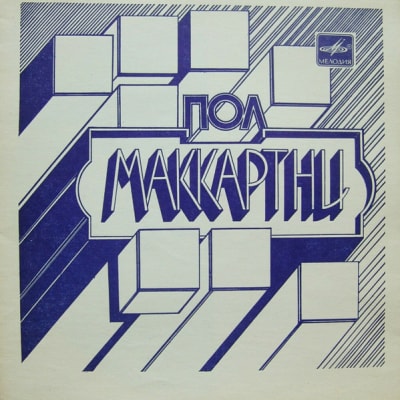
Paul McCartney
Я Люблю Тебя (I Love You)
Flexi-disc, 7", 33 ⅓ RPM · USSR · 1983

Riccardo Fogli
Collezione
Vinyl, LP, Compilation · USSR · 1984
Pupo
Pupo (Пупо)
Vinyl, LP, Album · USSR · 1985

Ricchi E Poveri
Ricchi e Poveri
Vinyl, LP, Album, Reissue · USSR · 1986
Adriano Celentano
Поет Адриано Челентано (Sings Adriano Celentano)
Vinyl, LP, Album, Repress · USSR · 1987

Mireille Mathieu
Любовь и Жизнь (Love and Life)
Vinyl, LP, Album, Repress · USSR · 1979